
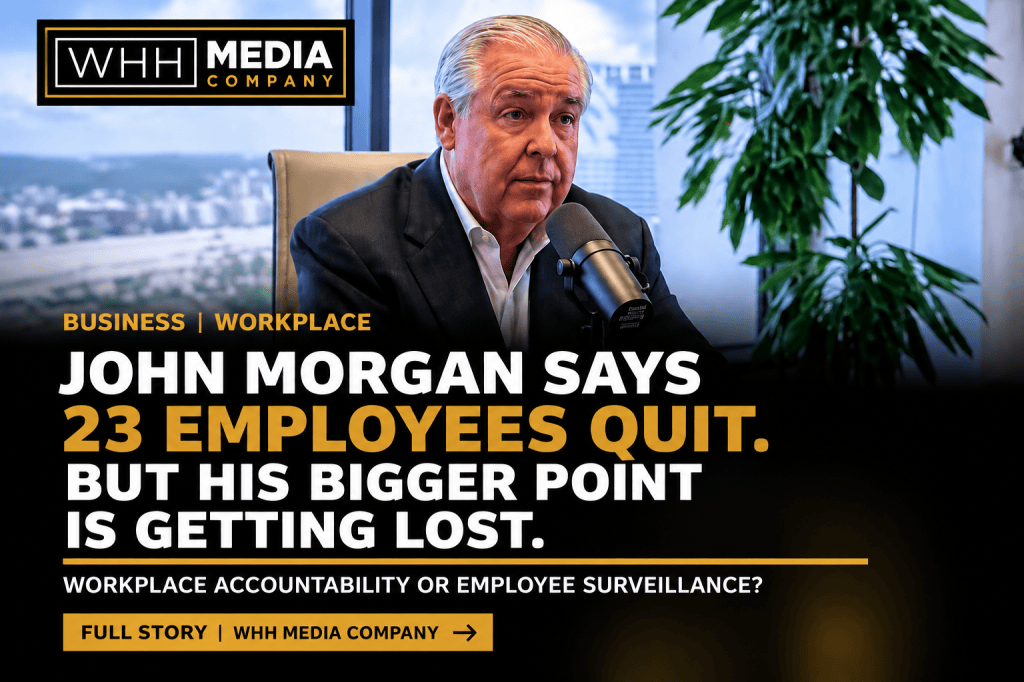
Florida attorney John Morgan is getting attention after making a blunt statement about remote work, productivity, and employee accountability.
“It’s not that they don’t want to work from home. They don’t want to f—ing work,” Morgan said.
The viral version of the story makes it sound like Morgan simply called remote workers lazy. That is not the full point he made.
Morgan appeared on the August 27 episode of The Iced Coffee Hour, hosted by Graham Stephan and Jack Selby. During the conversation, he said many employees did not want to return to the office. His firm allowed certain employees to keep working from home, but their productivity would be measured.
Morgan described a system that included a pixelated camera, keystroke tracking, and a productivity score. He said 23 employees quit during the first week.
His takeaway was clear. He believed some people were not fighting to work from home. They were fighting to work without being measured.
That may sound harsh, but the larger point deserves a fair conversation.
Remote work is still work
Businesses have a responsibility to pay employees properly. Employees also have a responsibility to complete the work they are being paid to do. Working from home does not remove that expectation.
Anyone who has tried to build a team understands the frustration of investing time in people who like the opportunity more than the responsibility attached to it. Applications and interviews can show interest. Consistent effort shows commitment.
Morgan made a similar point when he mentioned Tony Hsieh, the late CEO of Zappos. Zappos became known for giving newly trained employees an offer to leave. The company would pay their earned wages plus a bonus that eventually reached $2,000.
The purpose was not to punish people for leaving. It was to find out who truly wanted to stay before investing more time and training into them.
Morgan appeared to connect that idea to his own workplace. If the possibility of being measured caused someone to leave immediately, he questioned whether that person truly wanted the job.
That reasoning is understandable. It is also where careful reporting matters.
What do the resignations actually prove?
Morgan’s account establishes that 23 people quit after the monitoring policy was introduced. The timing supports his concern, but it does not tell us the individual reason each person left.
Some may not have wanted their productivity measured. Others may have objected to a camera inside their home. Some may have believed keystrokes would not fairly represent the value of their work.
Those possibilities do not make Morgan wrong about accountability. They show why companies must decide what they are actually trying to measure.
Keystrokes can measure activity. They cannot always measure judgment, problem solving, client relationships, or the quality of completed work. A camera can show that someone is sitting at a computer. It cannot automatically show whether that person is producing meaningful results.
Accountability works best when the measurement makes sense
Research on electronic performance monitoring adds another layer to the conversation. A meta-analysis published in Personnel Psychology reviewed 94 independent samples involving 23,461 workers. The researchers found no general evidence that electronic monitoring improved worker performance. They did find an association with increased stress. They also found that more transparent, less invasive monitoring was linked to more positive employee attitudes.
The American Psychological Association reported similar concerns in its 2023 Work in America Survey. The Harris Poll conducted the survey online among 2,515 employed adults in the United States. Among workers who reported being monitored, 56% said they typically felt tense or stressed during the workday. That compared with 40% of workers who did not report being monitored.
This does not mean businesses should stop measuring productivity. It means the system should be clear, relevant and transparent.
Employees should know what is being measured, why it matters and how the information will be used. Employers should focus on standards connected to actual performance instead of simply rewarding the appearance of being busy.
Morgan’s larger point should not get lost
Morgan was not arguing that every person who works from home is lazy. He acknowledged that some people can be trusted to work productively from home. His concern was that too many people want the freedom without the accountability.
That concern is fair.
Accountability is not a punishment. It is what allows workplace flexibility to survive. If employers cannot verify that work is being completed, remote arrangements become harder to defend. If employees are judged by tools that cannot recognize their real contributions, trust disappears.
The answer is not to eliminate measurement. It is to use better measurements.
Set clear expectations. Measure completed work. Explain how tracking systems operate. Make sure the technology supports the job instead of becoming the job.
Morgan’s words attracted attention because they were blunt. His larger message deserves attention because it reflects a real business problem. Freedom at work can only last when it is paired with responsibility. That responsibility should be measured by results that actually matter.
References
The Iced Coffee Hour. “People Are LAZY! Billionaire Exposes the BEST Ways to Make Money in 2026 (& Why 99% Will Fail).” August 27, 2026. https://www.youtube.com/watch?v=QcmFzUrhhrc
Flam, Charna. “Morgan & Morgan Billionaire Attorney Says He Told Remote Employees ‘We’re Going to Put a Camera Up Your Ass.’” People, September 1, 2026. https://people.com/morgan-and-morgan-billionaire-attorney-says-he-told-remote-employees-were-going-to-put-a-camera-up-your-ass-12074943
Canales, Katie. “How Tony Hsieh Paid New Zappos Workers $2,000 to Quit.” Business Insider, November 30, 2020. https://www.businessinsider.com/zappos-tony-hsieh-paid-new-workers-to-quit-the-offer-2020-11
American Psychological Association. “2023 Work in America Survey: Artificial Intelligence, Monitoring and Worker Stress.” https://www.apa.org/pubs/reports/work-in-america/2023-work-america-ai-monitoring
Ravid, Daniel M., Jerod C. White, David L. Tomczak, Ahleah F. Miles and Tara S. Behrend. “A Meta-Analysis of the Effects of Electronic Performance Monitoring on Work Outcomes.” Personnel Psychology 76, no. 1 (2023): 5–40. https://doi.org/10.1111/peps.12514
 WHH MEDIA COMPANY
Leave a comment