
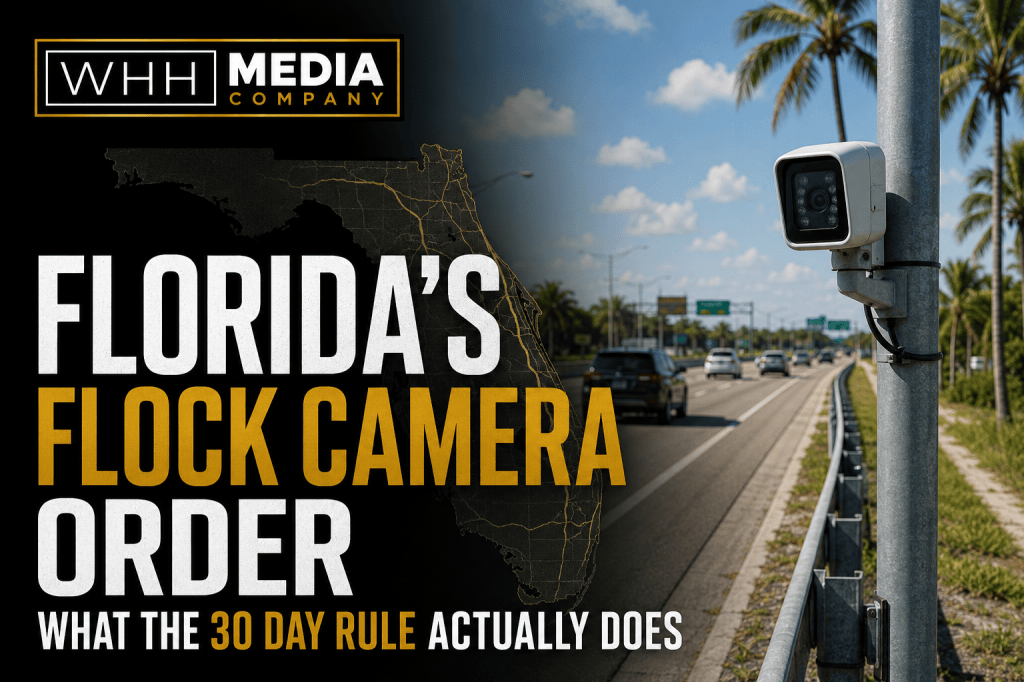
Florida is removing automated license plate readers from state highway property, but the order is more limited than some headlines and social media posts suggest.
On August 31, the Florida Department of Transportation revoked existing approvals for automated license plate recognition systems installed within the rights of way of roads belonging to the State Highway System.
Local law enforcement agencies were given 30 days to remove the affected cameras. FDOT said it would remove any devices that remain after the deadline. The department also stopped approving future requests to install these systems within its jurisdiction.
That does not mean every Flock camera in Florida is coming down.
What Florida’s Order Actually Covers
A state highway right of way includes the roadway and surrounding land controlled by the state. Depending on the location, that can include shoulders, medians, sidewalks, drainage areas, and roadside property.
The order applies to license plate readers installed within those areas.
It does not automatically apply to cameras located on county roads, city streets, commercial properties, apartment complexes, gated communities, or other privately controlled property.
Some law enforcement agencies and cities have decided to go further by suspending or removing their entire camera programs. Those are local decisions, not a requirement imposed on every camera in Florida.
The distinction matters because Flock Safety is only one company operating within a much larger network of automated license plate readers.
What These Cameras Collect
Automated license plate readers photograph passing vehicles and convert license plate images into searchable information connected to a location and time.
Flock Safety says its cameras can also record details such as a vehicle’s make, model, color, and other identifying characteristics. The company says its license plate readers do not use facial recognition.
A camera detection identifies a vehicle event. It does not determine who was driving, and it is not proof by itself that a specific person committed a crime.
Police departments use the technology to search for stolen vehicles, locate missing people, identify vehicles connected to investigations, and review where a vehicle was previously detected.
However, when enough detections are collected, the information may also reveal patterns about where a vehicle has traveled. That possibility is driving many of the privacy concerns surrounding the technology.
Why FDOT Took Action
The FDOT memorandum cited the rapid increase in camera deployments, reports of misuse, data privacy concerns, and surveillance schemes.
Governor Ron DeSantis also spoke publicly about the issue.
“What we don’t want in the state of Florida is to have a digital AI surveillance state where everything we’re doing is being tracked at all times,” DeSantis said.
He acknowledged that license plate readers may serve legitimate purposes but argued that limits are necessary when the information could be connected to criminal enforcement.
Florida Statute 316.0777 already gave FDOT authority over automated license plate readers installed within state highway rights of way. The law also says the systems cannot be used to issue traffic citations and must be removed within 30 days after FDOT gives notice.
A separate law, Florida Statute 316.0778, requires the state to establish a maximum retention period for records containing images and information collected by automated license plate readers.
Recent Cases Raised Questions About Oversight
The debate became more urgent after allegations that Florida law enforcement officers had used Flock’s database for personal reasons.
In Haines City, Officer Christopher Goodson was arrested after investigators alleged that he searched his estranged wife’s license plate 717 times between September 2024 and June 2026.
According to the arrest affidavit and statements attributed to the Haines City Police Department, the searches occurred while Goodson was both on and off duty. Investigators alleged that his estranged wife was not connected to a criminal investigation.
Goodson faces charges related to official misconduct and unauthorized computer activity. Those charges remain allegations unless proven in court.
Haines City Police said it does not intend to discontinue using Flock cameras. Police Chief Isaac Jackson instead ordered additional quarterly reviews to determine whether employees are accessing law enforcement systems for legitimate purposes.
That response points to one of the most important questions surrounding the technology.
Flock says database searches are logged, and users must provide a reason for conducting a search. But a log cannot prevent misuse by itself. Someone must review it, identify unusual activity, and intervene.
What This Means for Tampa
The City of Tampa’s April 2026 contract list shows an active automated license plate reader contract between the Tampa Police Department and Flock Safety Group.
The listed contract value is $43,450, with an end date of December 20, 2026.
That document does not reveal how many Tampa cameras are currently operating, how many are installed on state-controlled roads, or whether the affected cameras will be removed or relocated.
It also does not answer who can search Tampa’s license plate data, which outside agencies can access it, how long the information is retained, or how frequently search records are audited.
Other Tampa Bay agencies are responding differently. Axios Tampa Bay reported that Pinellas County Sheriff Bob Gualtieri plans to comply with the state road directive but does not currently plan to discontinue the agency’s broader use of the technology.
These are questions WHH Media Company intends to continue examining.
The Bigger Issue Is Accountability
License plate readers can be valuable when police are searching for a missing child, a stolen vehicle, or evidence connected to a serious crime.
The same technology can become dangerous when access is too broad, searches are not regularly reviewed, or information is used against someone who is not part of an investigation.
Florida’s order removes cameras from one category of public property. It does not resolve the larger debate surrounding local cameras, privately operated systems, data sharing, or employee access.
The real measure of public safety technology is not simply whether it can help solve a crime. The public should also be able to understand who controls it, how it is being used, and what happens when someone abuses that access.
Sources
- Florida Statute 316.0777
- Florida Statute 316.0778
- WUSF: FDOT revokes approvals for plate readers on state roads
- NBC 6: FDOT announces camera removal amid privacy concerns
- City of Tampa April 2026 Current Contracts Report
- FOX 13: Haines City officer accused of misusing Flock cameras
- Axios Tampa Bay: Local agencies respond to Florida’s order
- Flock Safety: How the technology works
 WHH MEDIA COMPANY
Leave a comment